- 9min read
Every bar owner who has ever stood in a loud room at 11 p.m. and thought this playlist is killing the vibe has had the same follow-up thought: we should get a jukebox.
The next question is where most people get stuck. Do you buy one outright, or do you place one with an amusement operator on a profit-sharing agreement?
The equipment ends up looking identical on the wall. What’s different is who carries the cost, who carries the work, and who gets a call at 9 p.m. on a Saturday when the bill acceptor jams. Here’s what setting up an AMI jukebox actually involves, and how the two paths compare.
What “setting up a jukebox” really means
Hanging the box on the wall is the easy part. A jukebox that actually earns needs all of this handled:
- Model selection. Wall-mount or floor model, single screen or dual screen, how much amplifier you need for the room.
- Placement. Sight lines, foot traffic, distance from the kitchen and the service well, and whether patrons can stand at it without blocking your bartenders.
- Power and mounting. A dedicated, non-switched outlet, and studs or blocking that can carry the weight.
- Connectivity. A stable connection that isn’t fighting fifty guest phones for bandwidth.
- Audio. Amplifier channels, speaker taps, zoning so the patio isn’t as loud as the main bar.
- Content configuration. Explicit-lyric filtering, artist and genre blocking, dayparting, and background music so the room is never silent between paid plays.
- Payments. Bill acceptor, credit card reader, and mobile app payments – plus reconciliation for all three.
- Music licensing. The part that quietly creates the most legal exposure.
- Promotion. Digital signage, app-based play, staff who know how to use the tools.
- Service. Parts, labor, and a plan for the day the touchscreen stops responding.
Every one of those items belongs to somebody. The real decision you’re making isn’t which jukebox – it’s who that somebody is.
Path 1: Buying the jukebox yourself
You can put an AMI jukebox in your venue as the owner of the equipment. AMI distributes through a nationwide network of amusement operators and distributors, so you’d purchase through a dealer rather than off a shelf.
Here’s the full cost stack you’re signing up for – not just the sticker:
| Cost | What it covers |
| Hardware | The jukebox itself, plus optional amplifier upgrades, dual bill acceptors, mounting kits, video kits |
| Freight and install | Shipping, lift-gate delivery, mounting hardware, an electrician if you need a new circuit |
| Music network subscription | An ongoing per-box fee to keep the catalog live and updating |
| Music licensing | Confirming your performance-rights coverage is correct and current |
| Card processing | Fees on every cashless play |
| Cash handling | Emptying the bill acceptor, counting, depositing, reconciling |
| Parts and labor | Bill validators, touchscreens, amplifiers, and card readers all wear out |
| Downtime | A dead jukebox on a Friday earns nothing and looks bad |
| Refresh cycle | Hardware ages; resale value on used commercial equipment is thin |
The effort side is harder to put on a spreadsheet. Somebody at your venue becomes the jukebox person. They handle the vendor calls, the coin-room reconciliation, the warranty claims, the service scheduling. In a business already short on management hours, that’s a real line item – it just doesn’t show up on a P&L.
Buying makes sense if: you want full control of the asset and the revenue, you already have a maintenance-capable team, and you’re comfortable owning depreciating hardware.
Path 2: Placing an AMI jukebox on profit share
Under a profit-sharing arrangement, the amusement operator owns the equipment and you provide the location. The operator handles procurement, installation, licensing, the network subscription, connectivity, service, collections, and reporting. You get a share of what the machine earns.
Your setup responsibilities shrink to three things:
- Pick the right spot with your operator.
- Provide power and wall or floor space.
- Keep your staff trained on the tools that drive plays.
That’s it. No capital outlay, no depreciating asset, no service contract to negotiate, and no scramble when a component fails.
Connectivity is a good example of the difference. Jukeboxes need constant, reliable connections for transactions and remote monitoring, and typical venue Wi-Fi struggles under a full house. Bar Partners solved this with a nationwide Verizon Fixed Wireless Access deployment, so machines run on standalone connectivity instead of competing with your guests – and cloud monitoring pushes an alert to our team when something goes wrong, often before anyone in your bar notices.
That’s the kind of infrastructure that’s difficult to justify for one machine and straightforward across a route of hundreds.
Cost and effort, side by side
| Buy it yourself | Profit share | |
| Upfront cost | Full hardware + install | None |
| Monthly network fee | Yours | Operator’s |
| Music licensing | Your responsibility to verify | Handled through the operator’s agreements |
| Service calls | You schedule and pay | Operator dispatches |
| Parts | Your cost | Operator’s cost |
| Cash collection | Your staff | Operator |
| Equipment upgrades | New purchase | Swapped as models refresh |
| Revenue | 100% of net, after all the above | An agreed share of collections |
| Your time | Ongoing | Setup conversation, then minimal |
| Risk if it underperforms | You own the machine | You keep your floor space |
The honest framing: ownership keeps more of each dollar but puts the cost, risk and work on you. Profit share gives you a smaller slice with minimal effort. For most independent bars and small groups, the second math wins – which is exactly why route operating exists as an industry.
Choosing the right AMI model for your room
AMI’s current lineup covers very different footprints:
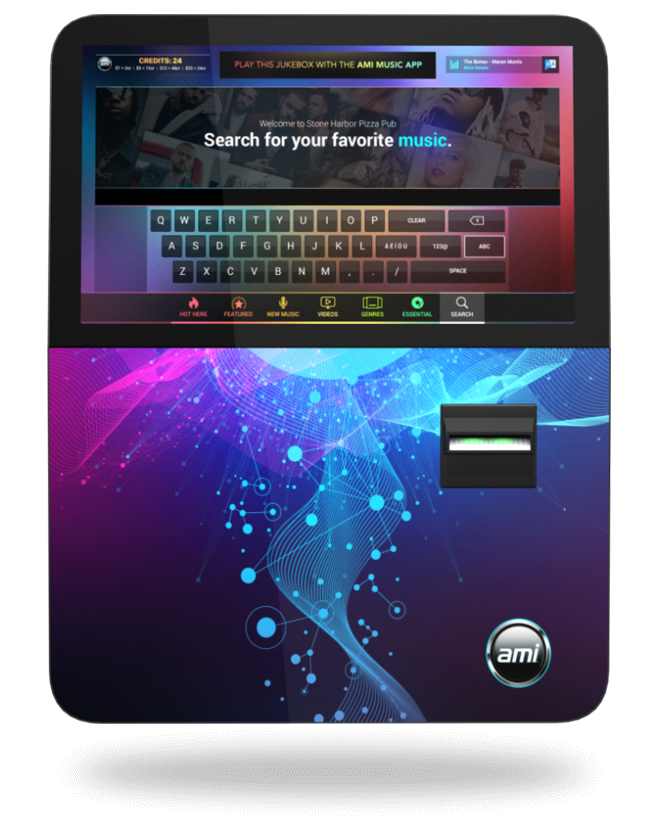
- Atom – 23.25″H × 18.5″W × 7.5″D, 33 lbs, with an 18.5″ HD touchscreen and a 250-watt two-channel amp. A one-person wall-mount install. Ideal for tight bars, small pubs, and game rooms where wall space is scarce.
- NGX Mini 3 – 31″H × 19.5″W × 8″D, with an illuminated frame and a 1,000-watt amp. The step up when you need real volume in a mid-size room.
- NGX Curve – dual 18.5″ screens, so the upper display runs music videos, trivia, and your own ads while patrons browse on the lower screen. A 1,000-watt four-channel amp and dual bill acceptors. Built for high-volume rooms.
- NGX Infinity – the 68.5″ floor model with a 23.8″ screen, a 12″ powered subwoofer, mid-bass drivers and tweeters, and infinity lighting that moves with the music. It’s a centerpiece, and at 400 lbs it rolls on wheels.
- Phantom – a compact module that turns your existing TVs into the jukebox display, with selection and payment through the AMI app. No bill acceptor, no cabinet, minimal wall impact.
A good operator will walk your room before recommending one. Ceiling height, wall construction, sight lines from the door, and where your regulars actually stand all matter more than the spec sheet.
Setup best practices that actually move revenue
Whichever path you choose, these are the details that separate a jukebox that pays for itself from one that becomes furniture:
Put it where people already stand. The single biggest driver of plays is visibility from the bar and the entrance. A jukebox in a dead corner earns like a jukebox in a dead corner.
Give it a non-switched outlet. If it dies when the closing crew hits the master switch, it misses overnight updates.
Keep it off the guest network. Payment processing and content updates deserve their own pipe.
Configure the filters before opening night. Block explicit lyrics if you serve a family crowd at lunch, restrict genres that clash with your concept, and schedule when jukebox play is available at all. Control is a feature – use it.
Never let the room go silent. AMI’s background music service fills the gaps between paid selections with licensed stations, so there’s no dead air when the queue empties.
Train your staff on Co-Pilot. Managers can adjust volume, change background stations, and build promotional ads right from a phone. That’s far better than a bartender reaching behind the machine.
Use the screen as advertising. AMI’s Ad Manager turns the display into digital signage for specials, events, and promotions, with templates that take minutes to schedule.
Push the app. Patrons who queue songs from their phones stay seated, keep ordering, and play more.
Don’t overlook music licensing
Note: the following does not constitute legal advice.
This is where a lot of venues quietly carry risk.
The Jukebox License Office issues a single agreement covering the ASCAP, BMI and SESAC catalogs – but it applies to traditional coin-operated jukeboxes, not internet-connected digital ones. For digital jukeboxes, performance licensing runs through the music network under separate agreements, which is why AMI’s catalog is described as fully licensed for commercial use.
Two things bar owners regularly get wrong:
- A jukebox license covers the jukebox – and only the jukebox. Live bands, DJs, karaoke, and music you stream through your house system from a phone or laptop all require separate coverage.
- The coverage has conditions. Digital jukebox licensing generally assumes patron-operated play in a venue that doesn’t charge admission, and doesn’t extend to using the jukebox as accompaniment to live entertainment.
Under a profit-sharing agreement, the operator holds the network relationship and handles licensing for the machine. If you own the box yourself, verifying that coverage is on you.
Frequently asked questions
Can I just buy an AMI jukebox for my bar? You can purchase through an AMI distributor, but you’ll still need an active music network account, licensing coverage, connectivity, and a service plan. Most venues find the ongoing obligations, not the purchase, are the hard part.
Do I still need an ASCAP, BMI, GMR or SESAC license if I have a jukebox? For the jukebox itself, licensing flows through the digital music network. But if you host live music, DJs, or karaoke, or play music through your house system, those uses require their own coverage (venues charging a cover or hosting karaoke nights need their own license).
Does the jukebox need its own internet connection? It needs a reliable one. Guest Wi-Fi is usually the wrong answer. Bar Partners installs machines on dedicated Verizon Fixed Wireless Access connectivity so transactions and monitoring never depend on your network.
How long does installation take? A wall-mounted Atom is a one-person job and goes up quickly. A 400-pound Infinity floor model takes more planning, though it rolls on wheels once it’s inside. Either way, your operator handles it.
What happens when something breaks? On profit share, the operator owns the parts and the labor. Cloud monitoring flags faults automatically, so a technician can often be dispatched before your staff notices the problem.
The short version
Setting up an AMI jukebox well means getting the model, placement, audio, connectivity, content settings, licensing, and service plan all right – and then keeping them right.
You can own all of that yourself. Or you can hand it to an operator who does it across hundreds of venues, pay nothing upfront, and simply collect your share.
Bar Partners installs, operates, and services AMI and TouchTunes jukeboxes at no cost to our partner venues. We supply the equipment, you supply the location, and we share the profits. Get started and we’ll walk your room.