
- 11min read
Here’s something most bar owners don’t realize until the jukebox is already on the wall: with TouchTunes, the box isn’t really the product. The network is.
TouchTunes runs jukeboxes in more than 65,000 venues across North America, and its app has a monthly user base in the millions, making it the #1 jukebox app. A meaningful share of the money that goes through a TouchTunes jukebox never touches the bill acceptor – it comes from phones, from people who already have credits loaded and already have the app open.
That changes what “setting one up” actually means. Hanging hardware is the easy part. Plugging into the network correctly, and getting your staff and your regulars using it, is where the revenue lives.
It also changes the buy-versus-profit-share math in a way that surprises people. Let’s walk through it.
First, the thing nobody tells you about buying one
You can walk into a distributor and buy an arcade cabinet. TouchTunes doesn’t work that way.
Browse any authorized TouchTunes distributor and you’ll find the same notice attached to the Angelina, the Angelina MP and the Virtuo: you must have a TouchTunes operator account to purchase the unit. And the jukeboxes themselves carry a plain warning that they require a license from TouchTunes to operate – without it, the machine doesn’t function. It isn’t a cabinet you own outright and plug in; it’s a terminal on somebody’s network.
That’s the single biggest practical difference between TouchTunes and buying, say, a pool table or a dartboard. The route-operator relationship isn’t a convenience layered on top of the hardware. It’s how the platform is built.
So for most independent venues, the real question isn’t should I buy or profit-share? It’s which operator do I want to work with, and what does that agreement look like?
What “setup” actually covers
A properly configured TouchTunes install involves a lot more than a bracket and an outlet:
- Model selection – wall footprint, screen size, and whether you want cash acceptance at all
- Placement – visible from the door and the bar, with room to stand and browse
- Power and mounting – a non-switched outlet and a wall that can carry 78 to 120 pounds
- Connectivity – reliable and separate from your guest Wi-Fi
- Sound – amplifier, speakers, and zoning so the dining room isn’t as loud as the main bar
- Music profile – genre profiles, background channels, playlists, and blocking rules that match your concept
- Payments – bill acceptance, card, and app credits, all reconciled
- Licensing – handled through the network, but with conditions worth understanding
- App activation – getting patrons checked in and playing from their phones
- Staff enrollment – this one gets skipped constantly, and it costs real money
- Service – parts, labor, and remote diagnostics when something fails
Each of those has an owner. Under an ownership model, that owner is you. Under profit sharing, it’s your operator.
The ownership path: what you’d be signing up for
Assume you clear the operator-account hurdle. Here’s the ongoing cost and effort stack:
Costs
- Hardware purchase through an authorized distributor
- Freight, mounting hardware, and any electrical work
- The TouchTunes license and network fees required to keep the box running
- Amplifier, speakers, and any multi-zone sound components
- Card processing fees on cashless plays
- Parts and labor once warranty ends – touchscreens, bill validators, cameras, amps
- Refresh cost when the platform moves on
Effort
- Cash collection, counting, deposit, reconciliation
- Vendor management and service scheduling
- Configuring and re-configuring music settings as your crowd changes
- Chasing downtime – a dark jukebox on a Saturday earns nothing and looks worse
That last category never shows up on a P&L, but it’s real. Somebody on your management team becomes the jukebox person, and management hours in a bar are the scarcest resource you have.
The profit-share path: what changes
Under a profit-sharing agreement, the operator owns the equipment and holds the TouchTunes relationship. They handle procurement, the license, installation, connectivity, sound, service, collections, and reporting. You provide the wall, the power, and the crowd. You share the revenue.
Your entire setup obligation reduces to three things:
- Pick the right spot with your operator during the walkthrough.
- Provide power and wall space.
- Get your team enrolled and engaged – more on this below, because it’s the highest-leverage thing you’ll do.
No capital outlay. No depreciating asset. No license to maintain. No service contract to negotiate.
Connectivity is a good illustration of the difference in scale. Jukeboxes need constant, reliable connections for transactions and remote diagnostics, and venue Wi-Fi tends to buckle on a busy night. Bar Partners deploys machines on dedicated Verizon Fixed Wireless Access rather than borrowing your network, with cloud monitoring that alerts our team to faults – often before your bartenders notice anything. That’s infrastructure that makes sense across hundreds of locations and almost never pencils out for one.
Side by side
| Buy it yourself | Profit share | |
| Operator account required | Yes – a real barrier | Held by your operator |
| Upfront hardware cost | Full | None |
| TouchTunes license & network fees | Yours | Operator’s |
| Sound system | Your purchase | Included in the install |
| Service & parts | Your cost, your scheduling | Operator dispatches |
| Cash collection | Your staff | Operator |
| Music configuration | You learn the platform | Operator configures, you direct |
| Hardware refresh | New purchase | Swapped as models update |
| Revenue | All of it, minus everything above | An agreed share of collections |
| Downside if it underperforms | You own the machine | You keep your floor space |
The trade is straightforward. Ownership means a larger share of a smaller net, plus permanent management overhead and a a long-term dependency on the TouchTunes network. Profit sharing means a smaller share with no capital at risk and minimal operational burden.
Matching the model to your room
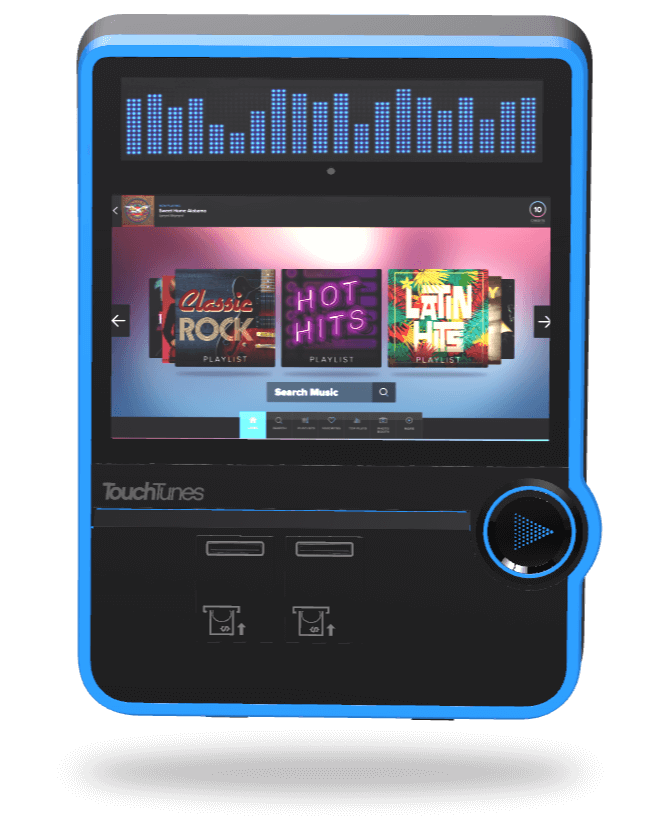
TouchTunes’ current lineup is three machines, and they’re genuinely different:
Angelina – 31″h × 24″w × 9.7″d, 88 lbs, 24″ HD touchscreen. Modular build with snap-in parts, which means faster service when something does fail. Adjustable visualizer, light show and brand bar. The default choice for most bars.
Angelina MP – 23.9″h × 24″w × 10.1″d, 78 lbs, same 24″ screen. The “MP” is mobile pay: patrons browse and search on the jukebox, but play and pay entirely through the app. No cash handling at all. If your crowd skews younger and app-native, or you simply don’t want a bill acceptor in the room, this is worth a serious look.
Virtuo – 40″h × 29″w × 10.4″d, 120 lbs, 27″ screen with an LED equalizer and dynamic messaging. The flagship and the showpiece. Built with separate components rather than the modular chassis. For high-volume rooms where the jukebox is meant to be a focal point.
All three include an HD camera and support the integrated PhotoBooth feature, which turns the jukebox into a second revenue line and a social-sharing engine on busy nights.
A good operator will walk your room before recommending one. Wall construction, sight lines from the entrance, ceiling height and where your regulars actually stand matter far more than the spec sheet.
Setup decisions that actually drive plays
Put it where people already congregate. Visibility from the bar and the front door is the single largest driver of plays. A jukebox in a dead corner performs like a jukebox in a dead corner, regardless of model.
Use a non-switched outlet. If the closing crew kills it at the breaker, it misses overnight updates and morning app check-ins.
Keep it off guest Wi-Fi. Payment processing and content updates deserve their own connection.
Set the music profile before opening night. TouchTunes gives you genre profiles, 20-plus background channels and 100-plus playlists to work from, plus blocking rules. Configure it to your concept – a brewery at 4 p.m. and a nightclub at midnight are not the same room.
Zone your sound. Multi-zone sound management lets you run the patio, the dining room and the main bar at different levels. Skipping this is the most common cause of “the jukebox is too loud” complaints – and of managers turning the whole thing down, which kills plays everywhere.
Enroll your staff in Team Rewards. This is the one venues leave on the table. TouchTunes’ Team Rewards program lets bartenders, servers, managers and owners earn free credits based on total app plays and check-ins at your venue – hit a play goal and every team member earns credits, with individual challenges on top. Staff need a TouchTunes app account and access to the jukebox remote to sign up, and they check in weekly on-site to keep earning. A bartender with a stake in the jukebox curates the room instead of ignoring it.
Push the app, not just the box. Credits never expire and work at any TouchTunes location, so regulars build a balance and spend it with you. Fast Pass lets impatient patrons pay to move up the queue on a busy night – that’s incremental revenue you get for free simply by having a crowd.
The licensing question
Music licensing is where venues quietly carry risk, and it works differently for internet-connected jukeboxes than for the old coin-operated kind.
The Jukebox License Office issues a single agreement covering the ASCAP, BMI and SESAC catalogs – but it applies to traditional coin-operated jukeboxes, not digital ones. For a networked jukebox, performance licensing runs through the platform. TouchTunes states that performances on its jukeboxes are licensed by ASCAP, BMI, SESAC or GMR in the United States, and licensing is handled through the TouchTunes network.
Two conditions bar owners regularly miss:
- That coverage typically assumes patron-operated play in a venue that doesn’t charge admission or a cover, and doesn’t extend to using the jukebox as accompaniment to live entertainment.
- It covers the jukebox and nothing else. Live bands, DJs, karaoke nights you run yourself, and music streamed through your house system from a phone or laptop all require separate coverage from the PROs.
Under profit sharing, your operator holds the network relationship and the licensing flows through it. If you own the box, verifying that coverage – and staying inside its conditions – is on you.
Frequently asked questions
Can I buy a TouchTunes jukebox for my bar? Authorized distributors require a TouchTunes operator account to sell you one, and the machine needs a license from TouchTunes to operate at all. For nearly all independent venues, placing one through a route operator is the practical path.
What’s the difference between the Angelina and the Angelina MP? The MP is mobile-pay only. Patrons still browse and search on the jukebox screen, but all playing and paying happens in the app. It’s slightly smaller and lighter, and there’s no cash to collect.
Do I still need an ASCAP, BMI or SESAC license? For the jukebox itself, licensing runs through the TouchTunes network. But live music, DJs, karaoke, and anything you play through your house system are separate and require your own coverage.
Does the jukebox need its own internet connection? It needs a reliable one, and guest Wi-Fi usually isn’t it. Bar Partners installs on dedicated Verizon Fixed Wireless Access so transactions and monitoring don’t depend on your network.
What happens when it breaks? On a profit-share agreement, parts and labor are the operator’s cost. The Angelina’s modular, snap-in construction was designed specifically to cut service time, and remote monitoring means faults are often flagged before staff notice.
Should I choose TouchTunes or AMI? Both are excellent, and the right answer depends on your room and your crowd. TouchTunes leads on app engagement and network reach; AMI is the only U.S. digital jukebox platform offering music video. Bar Partners places both, so we’ll recommend based on your venue rather than on what we happen to stock.
The short version
A TouchTunes jukebox isn’t a piece of equipment you own so much as a spot on a network you join. Buying one means clearing an operator-account requirement, carrying the license and network fees, and owning every service call and reconciliation forever.
Placing one through a route operator costs you nothing upfront and takes almost nothing from your week – and your job shrinks to the two things you’re actually good at: picking the right spot, and running a bar people want to be in.
Bar Partners installs, operates and services TouchTunes and AMI jukeboxes at no cost to our partner venues. We supply the equipment, you supply the location, and we share the profits. Get started and we’ll walk your room.